Somewhere around 18–22 weeks, pullets stop being freeloaders — and the setup that raised them stops being enough. The transition needs four things done right: a switch to layer feed with oyster shell offered on the side, nest boxes in place before the first egg, water that won’t freeze into a brick in January, and a plan for short winter days. Get those sorted and daily care for a laying flock is a calm ten minutes, morning and night.
Here’s how the transition works and the gear that carries it.
Know when it’s coming
Watch the birds, not the calendar. Combs and wattles redden up, and a pullet close to laying will squat flat when you reach toward her — that’s your two-week warning. Breed matters: production breeds like Red Sex-Links start near 18 weeks, heritage breeds can take 24 or more, and pullets that hit point-of-lay as the days are shortening may hold off until after midwinter.
Don’t rush the feed switch. Layer feed runs about 4% calcium — right for a hen building shells, hard on the kidneys of a bird that isn’t laying yet. Keep them on grower until the first eggs show up, then change the bag.
The feed switch, done properly
Two containers, two jobs:
Layer feed (16% protein) becomes the daily ration — a fresh bag from the local feed store beats anything shipped, same as always. A no-waste port feeder pays for itself here; billed-out feed on the floor is money, and it’s also the rodent buffet that brings mice into a Canadian coop every fall.
Oyster shell in its own dish, always available. Never mix it into the feed. Hens self-regulate calcium remarkably well — heavy layers take what they need, poor layers leave it — and a separate free-choice dish is how you let them. Thin, rubbery, or gritty-tipped shells are your sign the dish ran empty. Add a dish of grit too if the birds don’t free-range for their own.
Nest boxes before the first egg
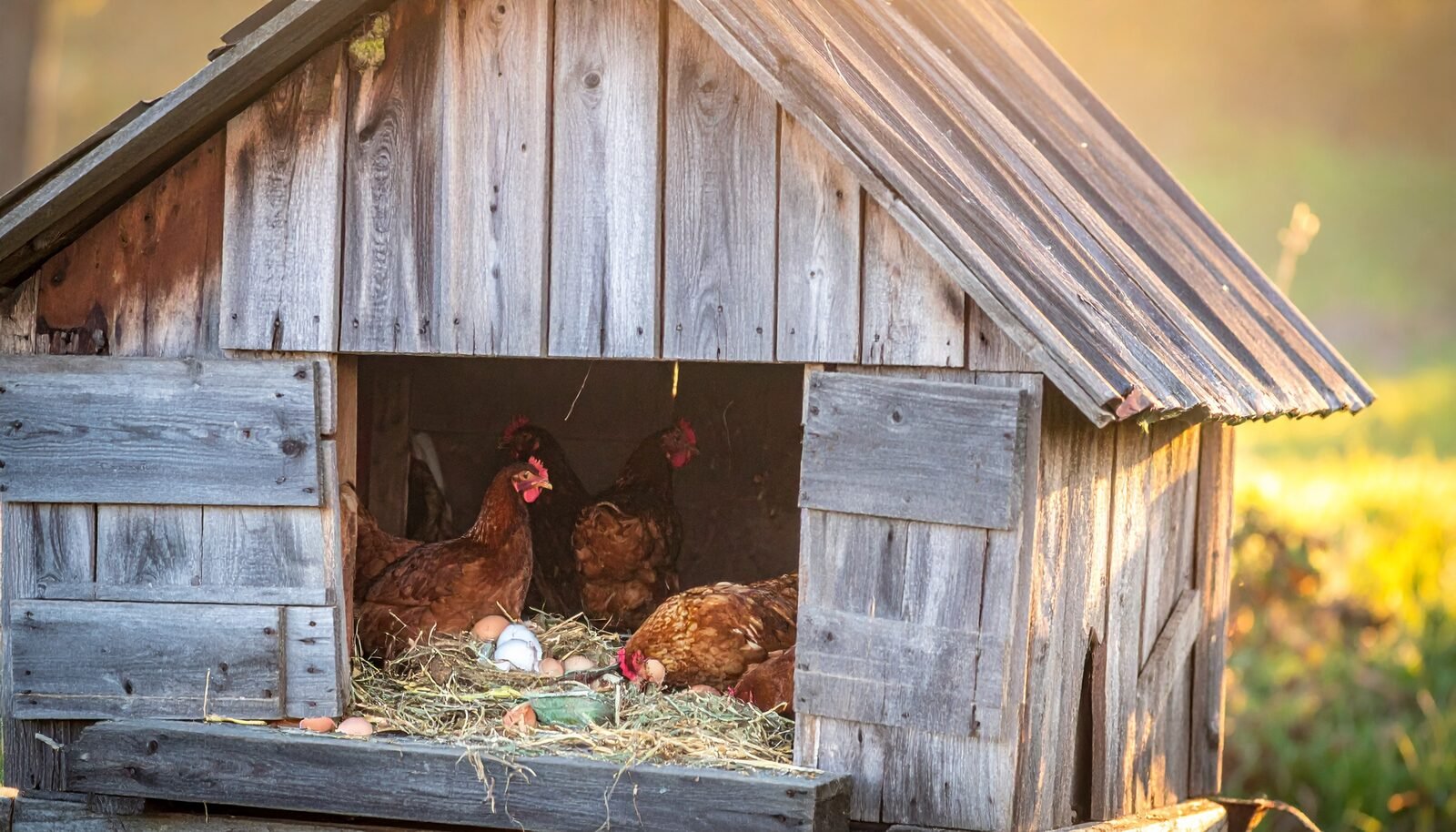
The habit you want is “eggs go in the box,” and it’s set early. Have boxes mounted a couple of weeks ahead: one box per 3–4 hens, roughly 30 × 30 cm, in the dimmest corner of the coop, and lower than the roosts — chickens sleep at the highest point available, and a hen sleeping in a nest box fills it with droppings nightly.
Put a ceramic or wooden training egg in each box; pullets take the hint. If you find floor eggs anyway, leave the fake eggs in and block the floor corner they’ve chosen — the habit usually corrects in a week or two. And if an egg-eating habit ever starts, roll-away nest box inserts end it by getting eggs out of reach as they’re laid.
Collect daily — twice daily in a Canadian winter, because an egg left in an unheated coop at -20°C freezes, cracks, and becomes both a mess and an invitation to egg-eating. Fresh eggs come with a natural coating (the bloom) that keeps bacteria out: don’t wash them unless they’re actually dirty, and store washed eggs in the fridge. If you’re thinking of selling a few dozen at the gate, check your province’s small-flock egg rules first — BC and Alberta both have them, and they’re easy to meet if you know them going in.
Water: the real Canadian problem
Three seasons of the year, cup waterers screwed into a bucket or pipe are the low-mess answer — clean water, no tipped founts, no green slime. We run exactly this setup and it’s on our gear page for a reason.
Then winter arrives, and frozen water becomes the number-one daily chore of every layer flock from Osoyoos to Grande Prairie. A heated poultry waterer (or a heated base under a metal fount) turns three kettle-hauling trips a day into a top-up. Run it off a proper outdoor-rated cord, keep connections off the ground and out of the snow, and still check twice a day at -20°C — a hen off water for a day drops laying for a week.
Winter light and cold
Hens need about 14 hours of light to keep laying; midwinter in BC and Alberta gives them eight. You have two honest options. Add light — a small LED on a timer, coming on in the early morning so birds still roost at natural dusk — and the eggs largely keep coming. Or let them take the natural winter break and accept the drop; plenty of small flocks do, and the birds don’t mind. What you shouldn’t do is stand in the coop in January wondering why laying stopped — it’s the light.
Cold itself is the lesser problem. A dry, draft-free coop with ventilation up high beats a heated one — trapped moisture, not temperature, is what causes frostbitten combs. For genuine cold snaps (Alberta’s -30°C weeks), a flat-panel carbon-fibre coop heater takes the edge off safely — no open element, no heat-lamp fire risk in a bedding-filled coop.
The layer kit
What to have in place before the first egg — links go to Amazon.ca. The heart of it also lives in the Layers section of our Gear We Use page.
- Nest boxes — metal roll-away or standard; one per 3–4 hens. Shop on Amazon.ca →
- Ceramic training eggs — cheap, and they set the habit that saves you an Easter egg hunt every morning. Shop on Amazon.ca →
- Oyster shell — free-choice calcium in its own dish; a bag lasts a small flock months. Shop on Amazon.ca →
- Poultry grit — for birds that don’t range for their own. Shop on Amazon.ca →
- No-waste port feeder — cuts spilled feed and the rodents that follow it. Shop on Amazon.ca →
- Cup waterers — the clean three-season water setup. Shop on Amazon.ca →
- Heated poultry waterer — the winter chore-killer. Shop on Amazon.ca →
- Outdoor timer for the coop light — 14 hours of light, automated. Shop on Amazon.ca →
- Carbon-fibre coop heater — safe heat for the brutal snaps. Shop on Amazon.ca →
- Egg cartons — because a laying flock produces faster than a fridge door holds. Shop on Amazon.ca →
- Basic poultry first aid — vet wrap and a poultry wound spray cover most of what actually happens. Shop on Amazon.ca →
From the feed store: layer feed, fresh and local.
Shop run and coop gear at the farm
A laying flock also earns a bigger, safer run — see our farm fencing and welded wire mesh panels for predator-tight expansion. We’re in Summerland, South Okanagan — get in touch for sizing, pricing and availability.
A quick note: The Humble Goat Stead is a participant in the Amazon.ca Associates Program. As an Amazon Associate we earn from qualifying purchases — at no extra cost to you. It helps keep the farm going, and we only point you to things we’d actually use.